In this blog post, you will learn about collective nouns for animals, which are special words used to name groups of animals as one unit. Instead of saying many individual animals, English uses words like pack, flock, and herd to describe them together. These words are an important part of English vocabulary and appear often in reading passages, stories, and real conversations.
Understanding collective nouns helps you build stronger communication skills. It improves your speaking because you can describe groups of animals more naturally. It supports your reading by helping you understand texts without confusion. It also strengthens your writing, making your sentences more accurate and expressive. Even in listening, you will recognize these terms easily when someone speaks about animals.
Collective Nouns for Animals
Collective nouns for animals are special words used to describe a group of animals as one unit. Instead of saying “many lions” or “many birds,” English uses words like a pride of lions or a flock of birds. These words make English more natural, accurate, and expressive.
Medieval Origins of Collective Nouns for Animals
Historical Background of Animal Group Names
Many collective nouns for animals and birds come from medieval English sources. These old texts often listed special “technical” terms that were supposedly used by hunters to describe groups of animals. However, most scholars believe these terms were not widely used in real hunting practice and were likely created for style or tradition rather than everyday communication.
Were These Terms Really Used?
It is uncertain whether hunters actually used many of these medieval collective nouns in real life. In most cases, there is little or no evidence showing that they were part of normal spoken language. Because of this, many experts consider them imaginative or symbolic rather than practical vocabulary.
Despite this, a few of these terms survived over time and eventually became part of standard English. From the 19th century onward, scholars carefully collected and repeated these medieval lists. As a result, many learners today still recognize them as the “correct” names for groups of animals, even though they are rarely used in everyday speech.
Modern Additions and Creative Terms
Over time, people began creating new collective nouns in the same style as the medieval ones. For example, a group of rhinoceroses is sometimes called a “crash.” These newer terms follow the same creative pattern but are not commonly used in real communication.
In modern English, people usually prefer simple and practical words instead of rare collective nouns. For example:
- A group of plovers, starlings, or owls is normally called a flock, not a congregation, murmuration, or parliament.
These more complex terms are interesting, but they are rarely found in natural conversation or writing.
Common vs Rare Collective Nouns
Today, English uses a mix of simple and traditional collective nouns:
Common and widely used examples:
- A pod of whales
- A pack of dogs
- A flock of birds
Rare or literary examples:
- A clowder of cats
- A descension of woodpeckers
While the rare terms are still known, they mostly appear in books, word lists, or language discussions rather than everyday English.
What Are Collective Nouns for Animals?
Collective nouns are words that describe a group of animals acting or living together.
For example:
- A pack of wolves
- A herd of cows
- A flock of birds
These words help speakers avoid repetition and sound more natural in English.
Why Learning Collective Nouns Is Important
Learning collective nouns helps you:
- Speak English more naturally
- Improve reading comprehension
- Understand stories, books, and news
- Build strong vocabulary for exams
- Communicate clearly in real-life situations
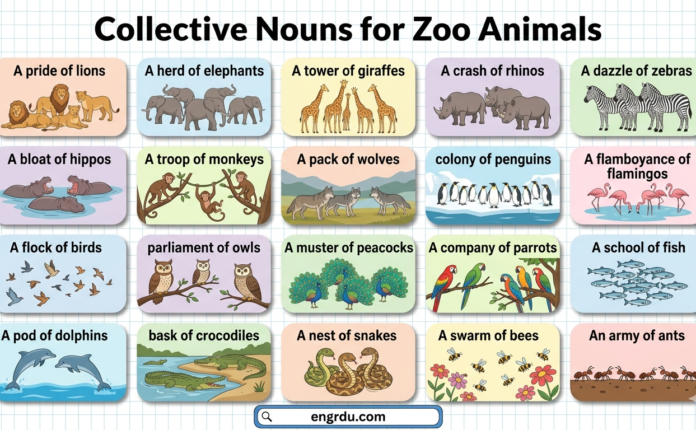
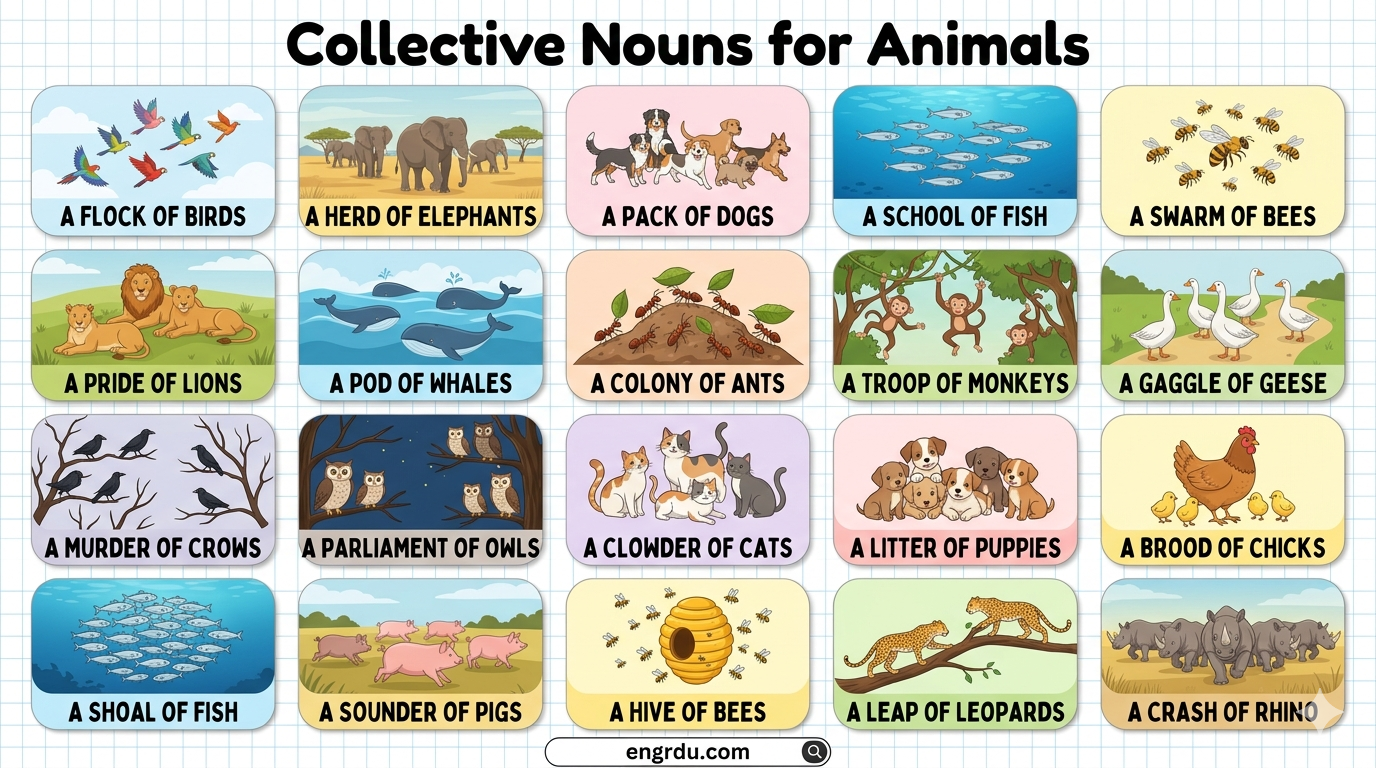
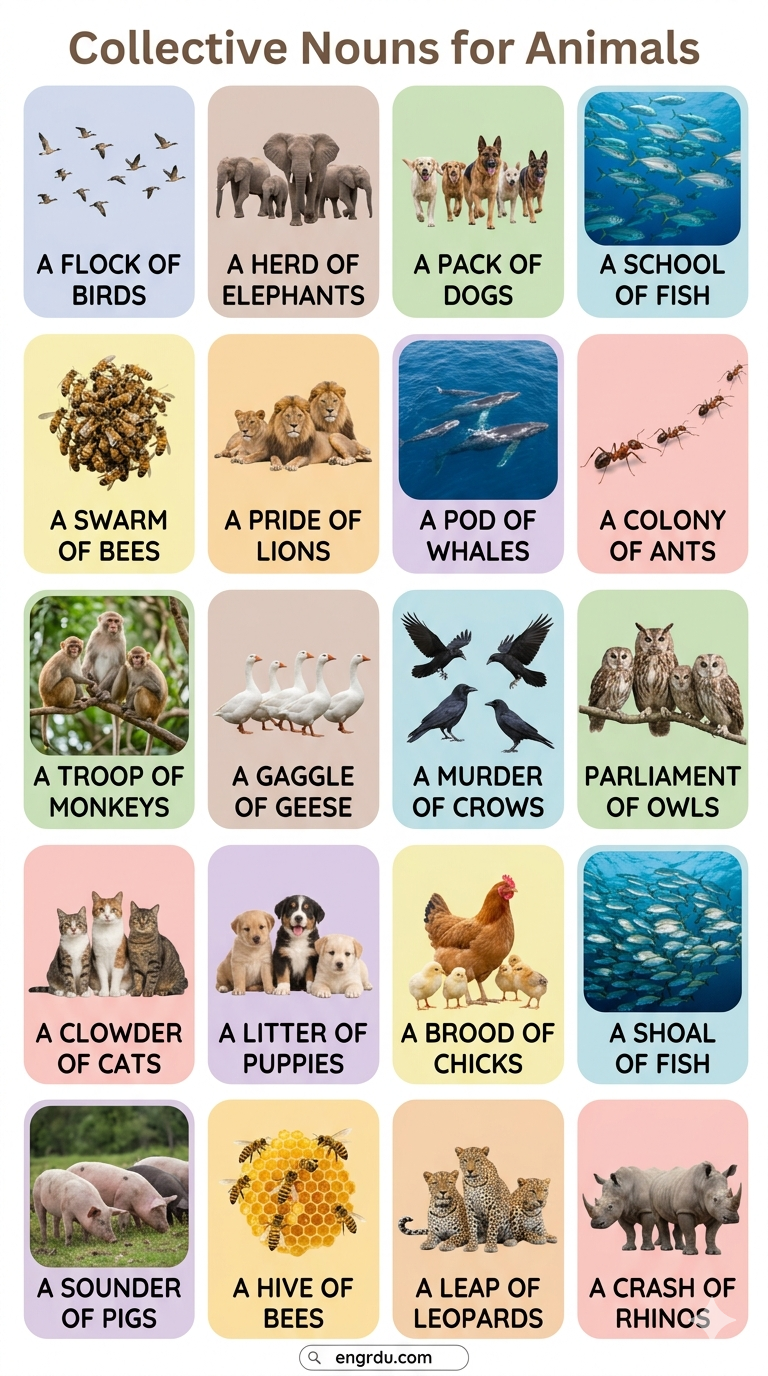
Common Collective Nouns for Animals with Pictures
Here are some basic ones every learner should know:
- Herd – large animals like cows, elephants
- Flock – birds like sheep, chickens
- Pack – wolves, dogs
- Swarm – bees, insects
- School – fish
- Colony – ants, penguins
Wildlife Collective Nouns
Wild animals often have unique group names:
- A pride of lions
- A pack of wolves
- A herd of elephants
- A leap of leopards
- A troop of monkeys
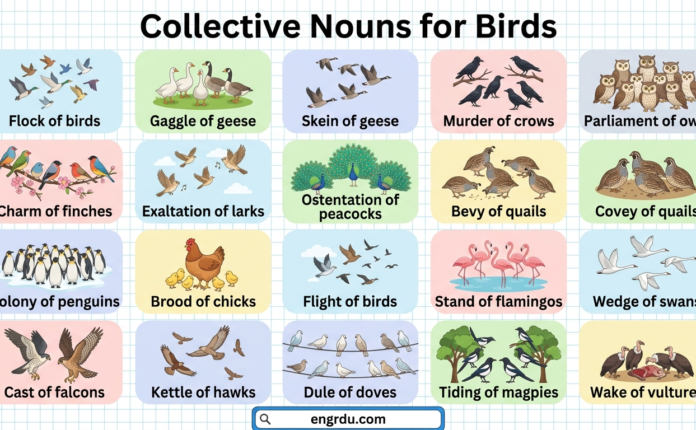
Birds and Insects Collective Nouns
Birds and insects have some of the most interesting group names:
- A flock of birds
- A murder of crows
- A parliament of owls
- A swarm of bees
- A colony of ants
- A nest of vipers
Farm Animal Collective Nouns
Farm animals often use simple and common collective nouns:
- A herd of cows
- A flock of sheep
- A team of horses
- A gaggle of geese
- A litter of puppies
Marine Animal Collective Nouns
Animals in the ocean also have special group names:
- A school of fish
- A pod of dolphins
- A shoal of fish
- A colony of seals
- A crash of rhinoceroses (rare but used in literature)
Animal Group Vocabulary List
Here is a clear vocabulary list to help you memorize quickly:
- Herd – group of large grazing animals like cows or deer
- Flock – group of birds or sheep
- Pack – group of wolves or wild dogs
- Swarm – large group of insects moving together
- School – group of fish swimming together
- Colony – group of ants, penguins, or seals
- Pride – group of lions living together
- Troop – group of monkeys or baboons
- Gaggle – group of geese on land
- Pod – group of dolphins or whales
- Litter – group of baby animals born at one time
- Brood – group of chicks or baby birds
- Leap – group of leopards
- Murder – group of crows
- Parliament – group of owls
- Crash – group of rhinoceroses
- Clowder – group of cats
- Drove – group of cattle or sheep being moved
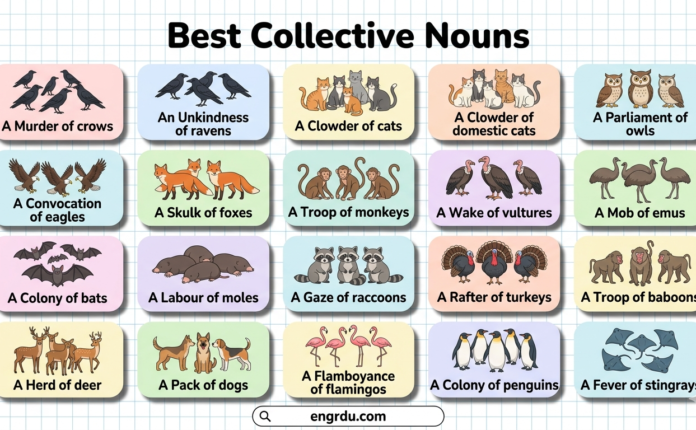
A to Z List of Group of Animals
| Animal | Collective Noun |
|---|---|
| apes | shrewdness |
| badgers | cete |
| bats | colony |
| bears | sloth / sleuth |
| bees | hive / swarm / bike |
| birds | flock / colony / flight / parcel |
| boars | singular |
| buffalo | herd / gang |
| butterflies | flight / wing |
| cats | clowder |
| cattle | herd / drove / mob |
| chicks | clutch / brood / peep |
| crows | murder |
| cubs | litter |
| deer | brace / leash |
| dogs | pack / leash / brace |
| dolphins | pod / school / herd |
| donkeys | herd / pace |
| doves | dole / dule |
| ducks | paddling / raft |
| elephants | herd |
| fish | school / shoal / run |
| foxes | skulk / leash / earth |
| geese | gaggle / skein / wedge |
| giraffes | herd |
| gnats | cloud |
| goats | flock / trip |
| gorillas | band |
| grouse | covey / brace / pack |
| hares | huske / leash / down |
| hawks | cast / kettle |
| herons | siege / sedge |
| horses | herd / string / span |
| hounds | pack / kennel / cry |
| insects | swarm / cloud |
| jellyfish | smack |
| kangaroos | mob / troop / flock |
| kittens | kindle |
| larks | exaltation / bevy |
| leopards | leap |
| lions | pride |
| magpies | tidings |
| moles | labour |
| monkeys | troop |
| mules | span / string |
| owls | parliament |
| oxen | yoke |
| partridges | covey |
| peacocks | muster |
| pigeons | kit |
| plovers | congregation / wing |
| ponies | string |
| porpoises | pod / school / herd |
| rabbits | berry |
| ravens | unkindness |
| rhinoceroses | crash |
| seals | spring / plump |
| sheep | flock / fold |
| sparrows | host |
| squirrels | dray |
| starlings | murmuration |
| swans | wedge |
| swine | sounder / drift |
| toads | knot |
| turkeys | rafter |
| vipers | nest |
| whales | pod / gam / herd |
| wolves | pack |
| woodpeckers | descension |
Usage Examples in Sentences
Learning through examples helps you remember better:
- A herd of elephants is walking slowly across the grassland.
- A flock of sheep is moving toward the barn.
- A swarm of bees flew out of the hive.
- A school of fish changed direction quickly.
- A troop of monkeys climbed the trees together.
Learning Tips
To master collective nouns for animals:
- Read short English stories or animal books
- Practice making your own sentences daily
- Group words by categories (birds, farm, wild animals)
- Repeat aloud to improve memory
- Use them in real conversation whenever possible
Conclusion
Collective nouns for animals are an important part of English vocabulary. They help you speak and write more naturally while improving your understanding of real-world English. By learning and practicing these words step by step, you can build strong communication skills and sound more fluent in English.
Related Articles:
- Collective Nouns Definition and Examples
- 100+ Collective Noun Examples in English
- Top 100 Collective Nouns in Sentences
FAQs about Collective Nouns for Animals
What are collective nouns for animals?
Collective nouns for animals are special words used to describe groups of animals as one unit, such as a flock of birds or a pack of wolves.
What is a common collective noun for animals?
Common collective nouns include herd, flock, pack, and school. These words describe groups like cows, birds, wolves, and fish in simple English.
What is a flock of animals?
A flock usually refers to a group of birds or sheep moving or living together. It is one of the most frequently used collective nouns in English.
What is a pack of animals?
A pack is a group of wild or domestic dogs, especially wolves. It shows animals that hunt, live, or move together in a coordinated way.
What is the collective noun for lions?
The collective noun for lions is a pride. A pride of lions usually lives and hunts together in groups within their natural habitat.
What is the collective noun for fish?
The collective noun for fish is a school. A school of fish swims together in the same direction for protection and better movement.