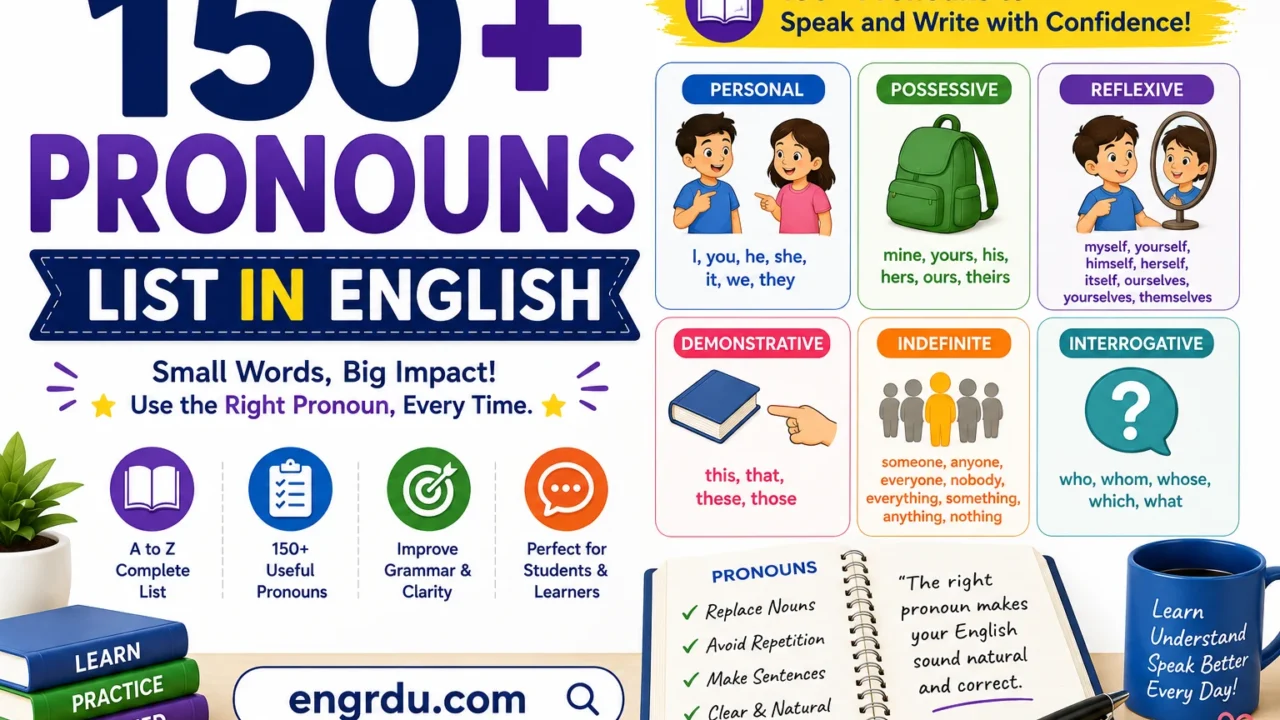
Have you ever noticed how often words like I, you, they, someone, this, who, and themselves appear in everyday English? This List of Pronouns brings together more than 150 useful pronoun forms, including personal, possessive, reflexive, demonstrative, interrogative, relative, indefinite, reciprocal, distributive, archaic, and gender-neutral forms.
Pronouns replace or stand in for nouns and noun phrases, helping English speakers avoid unnecessary repetition. Different grammar sources group pronouns in slightly different ways, and some forms can work as pronouns or determiners depending on their position in a sentence.
What Is a Pronoun?
A pronoun is a word that can stand in for a noun or noun phrase. Instead of repeatedly naming the same person, object, animal, place, or idea, English often uses a pronoun.
For example, Maria can become she, the children can become they, and a previously mentioned object can become it.
Pronouns can show person, number, case, gender, possession, reference, or relationship. Their forms also change according to grammatical function.
English has a relatively small core pronoun system. A university grammar resource describes pronouns as a closed class with about 100 core forms, while broader lists may include archaic, dialectal, informal, and newer gender-neutral forms.
Related Resources: Pronoun Definition and Types in English Grammar
Types of Pronouns in English
English grammar references commonly identify personal, possessive, reflexive, demonstrative, interrogative, relative, and indefinite pronouns. Reciprocal pronouns are also widely treated as a separate category.
Some grammar systems also discuss intensive, distributive, dummy, generic, archaic, dialectal, and gender-neutral forms separately.
Common Pronouns
Common pronouns appear constantly in speaking and writing. They include personal forms, object forms, possessive forms, reflexive forms, demonstratives, interrogatives, relatives, and indefinite forms.
| Pronoun | Pronoun | Pronoun |
|---|---|---|
| I | me | you |
| he | him | she |
| her | it | we |
| us | they | them |
| this | that | these |
| those | who | whom |
| whose | which | what |
| someone | somebody | something |
| anyone | anybody | anything |
| everyone | everybody | everything |
| no one | nobody | nothing |
| each | either | neither |
| one | none | all |
| some | any | many |
| few | several | both |
| myself | yourself | himself |
| herself | itself | ourselves |
| yourselves | themselves | each other |
| one another | mine | yours |
| his | hers | ours |
| theirs | whoever | whatever |
Personal Pronouns
Personal pronouns identify speakers, listeners, people, animals, objects, or groups. They change according to person, number, grammatical case, and, in some forms, gender.
| Subject Pronouns | Object Pronouns | Personal Pronouns |
|---|---|---|
| I | me | you |
| he | him | she |
| her | it | we |
| us | they | them |
| you | them | it |
First-Person Pronouns
| Pronoun | Pronoun | Pronoun |
|---|---|---|
| I | me | we |
| us | myself | ourselves |
| mine | ours | ourself |
| oneself | me-self | ourself |
Second-Person Pronouns
| Pronoun | Pronoun | Pronoun |
|---|---|---|
| you | your | yours |
| yourself | yourselves | ye |
| thee | thou | thy |
| thine | thyself | youse |
| y’all | y’all’s | y’allselves |
Third-Person Pronouns
| Pronoun | Pronoun | Pronoun |
|---|---|---|
| he | him | his |
| himself | she | her |
| hers | herself | it |
| its | itself | they |
| them | theirs | themselves |
| one | oneself | one’s |
Possessive Pronouns
Possessive pronouns indicate ownership or association. The independent possessive forms include mine, yours, his, hers, ours, theirs, its, and whose in grammatical systems that recognize its and whose as possessive pronouns. Some teaching systems distinguish these from possessive determiners such as my, your, our, and their.
| Possessive Pronoun | Possessive Pronoun | Possessive Pronoun |
|---|---|---|
| mine | yours | his |
| hers | ours | theirs |
| its | whose | thine |
| thine | mine | yours |
| hers | ours | theirs |
Possessive Forms Often Confused With Pronouns
| Possessive Form | Possessive Form | Possessive Form |
|---|---|---|
| my | your | his |
| her | its | our |
| their | whose | thy |
| mine | yours | hers |
| ours | theirs | thine |
Important: my, your, our, and their normally function as possessive determiners when they come directly before a noun. Mine, yours, ours, and theirs function independently.
Reflexive Pronouns
Reflexive pronouns point back to a noun or pronoun in the same clause. Standard English reflexive forms generally end in -self or -selves.
| Reflexive Pronoun | Reflexive Pronoun | Reflexive Pronoun |
|---|---|---|
| myself | yourself | himself |
| herself | itself | ourselves |
| yourselves | themselves | oneself |
| themself | ourself | thyself |
| yourself | yourselves | himself |
| herself | itself | themselves |
Intensive Pronouns
Intensive pronouns have the same forms as reflexive pronouns but are used to add emphasis rather than serve as the object required by the verb.
| Intensive Form | Intensive Form | Intensive Form |
|---|---|---|
| myself | yourself | himself |
| herself | itself | ourselves |
| yourselves | themselves | oneself |
| themself | ourself | thyself |
Demonstrative Pronouns
Demonstrative pronouns point to particular people, objects, places, ideas, or things. The core English forms are this, that, these, and those.
| Demonstrative Pronoun | Demonstrative Pronoun | Demonstrative Pronoun |
|---|---|---|
| this | that | these |
| those | such | same |
| former | latter | the former |
| the latter | suchlike | that one |
This and these generally indicate something nearer in space, time, or discussion, while that and those can indicate something farther away or previously mentioned.
Interrogative Pronouns
Interrogative pronouns introduce questions about people, things, identity, ownership, or choice.
| Interrogative Pronoun | Interrogative Pronoun | Interrogative Pronoun |
|---|---|---|
| who | whom | whose |
| what | which | whatever |
| whoever | whosoever | whomever |
| whichever | whatso | whoe’er |
The most established interrogative pronouns are who, whom, whose, what, and which.
Relative Pronouns
Relative pronouns connect a relative clause with a noun or noun phrase already mentioned. Common forms include who, whom, whose, which, and that.
| Relative Pronoun | Relative Pronoun | Relative Pronoun |
|---|---|---|
| who | whom | whose |
| which | that | whoever |
| whomever | whatever | whichever |
| whosoever | whomsoever | whatsoever |
Who and whom usually refer to people, while which commonly refers to things. That can introduce defining relative clauses for people or things.
Indefinite Pronouns
Indefinite pronouns refer to people, things, amounts, or groups without identifying a particular person or thing.
This category contains many of the longest groups in English because it includes forms built with -body, -one, -thing, and other indefinite expressions. Cambridge also identifies indefinite forms such as everyone, everybody, everything, someone, somebody, something, no one, nobody, and nothing.
Indefinite Pronouns for People
| Indefinite Pronoun | Indefinite Pronoun | Indefinite Pronoun |
|---|---|---|
| anyone | anybody | someone |
| somebody | everyone | everybody |
| no one | nobody | each |
| either | neither | one |
| another | others | all |
| both | few | many |
| several | some | none |
| whoever | whomever | whoever |
| each one | either one | neither one |
Indefinite Pronouns for Things
| Indefinite Pronoun | Indefinite Pronoun | Indefinite Pronoun |
|---|---|---|
| anything | something | everything |
| nothing | everything | whatever |
| whichever | whatever | something |
| anything | nothing | none |
| all | some | any |
| much | little | enough |
| more | most | less |
| least | none | another |
Indefinite Quantifier Pronouns
| Pronoun | Pronoun | Pronoun |
|---|---|---|
| all | any | both |
| each | either | enough |
| few | fewer | little |
| less | many | more |
| most | much | neither |
| none | several | some |
| plenty | enough | another |
| others | fewest | least |
Reciprocal Pronouns
Reciprocal pronouns express a mutual relationship between people or groups. The two established English reciprocal pronouns are each other and one another.
| Reciprocal Pronoun | Reciprocal Pronoun | Reciprocal Pronoun |
|---|---|---|
| each other | one another | each other’s |
| one another’s | eachother | one-another |
The standard written forms are each other, each other’s, one another, and one another’s.
Distributive Pronouns
Distributive pronouns refer to members of a group individually rather than treating the group as one unit.
| Distributive Pronoun | Distributive Pronoun | Distributive Pronoun |
|---|---|---|
| each | either | neither |
| each one | either one | neither one |
| each of | either of | neither of |
| each other | one another | every one |
In traditional grammar teaching, each, either, and neither are the most commonly identified distributive forms.
Archaic Pronouns
Older forms remain important when reading historical English, older literature, religious texts, poetry, and historical documents. Forms such as thou, thee, thy, thine, thyself, and ye are associated with older stages or varieties of English.
| Archaic Pronoun | Archaic Pronoun | Archaic Pronoun |
|---|---|---|
| thou | thee | thy |
| thine | thyself | ye |
| yeer | yeers | yeerself |
| yeerselves | yonder | whoso |
| whomsoever | whosoever | whatsoever |
| wheresoever | whencesoever | thither |
| hither | hence | whither |
Gender-Neutral Pronouns and Neopronouns
Modern English uses they/them as gender-neutral pronouns in both plural contexts and singular contexts. Singular they is now widely recognized in contemporary English, although usage and style preferences can vary.
Neopronouns are newer or less traditional pronoun sets used by some people. They are not part of the standard core pronoun inventory taught in most English grammar courses.
| Gender-Neutral Form | Gender-Neutral Form | Gender-Neutral Form |
|---|---|---|
| they | them | their |
| theirs | themself | themselves |
| xe | xem | xyr |
| xyrs | xemself | ze |
| hir | hirs | hirself |
| zie | zim | zir |
| zirs | zirself | ey |
| em | eir | eirs |
| eirself | ve | ver |
| vis | verself | per |
| pers | perself | fae |
| faer | faers | faerself |
| co | cos | coself |
| thon | thons | thonself |
| ne | nir | nirs |
| nirs | nirself | ae |
| aer | aers | aerself |
List of Pronouns from A to Z
The A–Z section below focuses on unique written forms, including standard pronouns and recognized extended forms. Multi-word forms are retained where they represent established pronoun expressions.
Because English has a relatively small core pronoun system, not every alphabet letter has a standard pronoun. Some letters therefore have no conventional English pronoun entries.
Pronouns Beginning with A
| Pronoun | Pronoun | Pronoun |
|---|---|---|
| all | another | anyone |
| anybody | anything | either |
| each | eachother | each one |
| either one | either of | all of |
| any | anybody | anything |
Pronouns Beginning with B
| Pronoun | Pronoun | Pronoun |
|---|---|---|
| both | both of | boths |
| bunch | bunches | but |
| both one | both ones | both themselves |
Note: The standard pronoun inventory contains very few established forms beginning with B. Some words found in broad online lists are better classified as nouns, determiners, conjunctions, or informal constructions.
Pronouns Beginning with C
| Pronoun | Pronoun | Pronoun |
|---|---|---|
| each | co | cos |
| coself | co’s | certain |
| certain ones | certain others | certain one |
Pronouns Beginning with D
| Pronoun | Pronoun | Pronoun |
|---|---|---|
| de | dey | dem |
| dat | dis | dose |
| datself | demselves | dems |
| disself | dose selves | deyself |
These forms include dialectal, nonstandard, or neopronoun usage and should not be confused with the core standard pronoun system.
Pronouns Beginning with E
| Pronoun | Pronoun | Pronoun |
|---|---|---|
| each | either | everyone |
| everybody | everything | either one |
| each one | each other | each other’s |
| ey | em | eir |
| eirs | eirself | eyself |
Pronouns Beginning with F
| Pronoun | Pronoun | Pronoun |
|---|---|---|
| few | fewer | fewest |
| fae | faer | faers |
| faerself | few ones | few others |
Pronouns Beginning with G
| Pronoun | Pronoun | Pronoun |
|---|---|---|
| ge | gem | ges |
| gemself | geself | greater ones |
Note: Standard English has no major traditional pronoun series beginning with G. Most forms in this section belong to newer or nonstandard systems.
Pronouns Beginning with H
| Pronoun | Pronoun | Pronoun |
|---|---|---|
| he | him | his |
| her | hers | herself |
| himself | hirs | hir |
| hirself | hirm | hirselfs |
Pronouns Beginning with I
| Pronoun | Pronoun | Pronoun |
|---|---|---|
| I | it | its |
| itself | either | either one |
| either of | it-all | its own |
Pronouns Beginning with J
| Pronoun | Pronoun | Pronoun |
|---|---|---|
| je | jem | jeir |
| jeirs | jemself | jeirself |
| jey | jeys | jeyself |
Note: English does not have a traditional standard pronoun series beginning with J. These forms occur mainly in newer or nonstandard pronoun systems.
Pronouns Beginning with K
| Pronoun | Pronoun | Pronoun |
|---|---|---|
| ke | kem | kes |
| kemself | keself | kirs |
| kir | kirs | kirself |
Pronouns Beginning with L
| Pronoun | Pronoun | Pronoun |
|---|---|---|
| little | less | least |
| latter | latter one | latter ones |
| lots | lot | lesser |
Pronouns Beginning with M
| Pronoun | Pronoun | Pronoun |
|---|---|---|
| me | mine | myself |
| many | more | most |
| much | more of | most of |
| many others | many ones | much of |
Pronouns Beginning with N
| Pronoun | Pronoun | Pronoun |
|---|---|---|
| nobody | no one | nothing |
| none | neither | neither one |
| neither of | no-one | neither one |
| naught | nought | ne |
| nir | nirs | nirself |
Pronouns Beginning with O
| Pronoun | Pronoun | Pronoun |
|---|---|---|
| one | oneself | one’s |
| ours | ourself | ourselves |
| one another | one another’s | other |
| others | other’s | others’ |
Pronouns Beginning with P
| Pronoun | Pronoun | Pronoun |
|---|---|---|
| plenty | plenty of | per |
| pers | perself | particular |
| particular one | particular ones | persons |
Pronouns Beginning with Q
| Pronoun | Pronoun | Pronoun |
|---|---|---|
| que | quem | queer |
| whoever | whichever | whatever |
The standard English pronoun inventory contains no major traditional pronoun series beginning with Q.
Pronouns Beginning with R
| Pronoun | Pronoun | Pronoun |
|---|---|---|
| reciprocal forms | relative forms | reflexive forms |
| rather | remainder | rest |
| remaining | respective | rest of |
Pronouns Beginning with S
| Pronoun | Pronoun | Pronoun |
|---|---|---|
| she | her | hers |
| herself | some | someone |
| somebody | something | several |
| such | same | some others |
| some one | some ones | selves |
Pronouns Beginning with T
| Pronoun | Pronoun | Pronoun |
|---|---|---|
| they | them | their |
| theirs | themselves | that |
| those | this | these |
| thou | thee | thy |
| thine | thyself | that one |
| those ones | these ones | themself |
Pronouns Beginning with U
| Pronoun | Pronoun | Pronoun |
|---|---|---|
| us | you | whoever |
| u | um | uus |
| uuse | uuz | uuzself |
Most forms in the second half of this table are newer or nonstandard rather than traditional English pronouns.
Pronouns Beginning with V
| Pronoun | Pronoun | Pronoun |
|---|---|---|
| ve | ver | vis |
| vers | verself | veir |
| veirs | veirself | vey |
| veyself | ver’s | viself |
Pronouns Beginning with W
| Pronoun | Pronoun | Pronoun |
|---|---|---|
| we | us | who |
| whom | whose | which |
| what | whoever | whomever |
| whatever | whichever | whosoever |
| whomsoever | whatsoever | whoso |
| whither | whereof | wherein |
| whereupon | whereby | wherewith |
| whencesoever | wheresoever | wherewithal |
Pronouns Beginning with X
| Pronoun | Pronoun | Pronoun |
|---|---|---|
| xe | xem | xyr |
| xyrs | xemself | xyrself |
| xey | xyrself | xyrsels |
Pronouns Beginning with Y
| Pronoun | Pronoun | Pronoun |
|---|---|---|
| you | your | yours |
| yourself | yourselves | ye |
| y’all | y’all’s | youse |
| yeer | yeers | yeerself |
| yeerselves | yerself | yoursens |
Pronouns Beginning with Z
| Pronoun | Pronoun | Pronoun |
|---|---|---|
| ze | zie | zim |
| zir | zirs | zirself |
| zeir | zeirs | zeirself |
| zey | zeys | zeyself |
Pronouns by Grammatical Function
Looking at pronouns by function can make grammar study easier than memorizing isolated words.
Subject Pronouns
| Pronoun | Pronoun | Pronoun |
|---|---|---|
| I | you | he |
| she | it | we |
| they | thou | ye |
| one | who | whoever |
Object Pronouns
| Pronoun | Pronoun | Pronoun |
|---|---|---|
| me | you | him |
| her | it | us |
| them | thee | whom |
| whomever | xem | zim |
Independent Possessive Pronouns
| Pronoun | Pronoun | Pronoun |
|---|---|---|
| mine | yours | his |
| hers | ours | theirs |
| its | whose | thine |
| one’s | y’all’s | theirs |
Reflexive Forms
| Pronoun | Pronoun | Pronoun |
|---|---|---|
| myself | yourself | himself |
| herself | itself | ourselves |
| yourselves | themselves | oneself |
| themself | ourself | thyself |
Pronouns for People
Pronouns referring to people include personal, indefinite, interrogative, relative, reciprocal, and gender-neutral forms.
| Pronoun | Pronoun | Pronoun |
|---|---|---|
| I | me | you |
| he | him | she |
| her | we | us |
| they | them | who |
| whom | whose | whoever |
| someone | somebody | anyone |
| anybody | everyone | everybody |
| nobody | no one | each |
| either | neither | one |
| another | others | oneself |
Pronouns for Things
Pronouns can refer to objects, ideas, animals, events, and other non-human references.
| Pronoun | Pronoun | Pronoun |
|---|---|---|
| it | this | that |
| these | those | what |
| which | whatever | whichever |
| something | anything | everything |
| nothing | all | some |
| any | none | much |
| little | more | most |
| less | least | enough |
Pronouns for Groups
| Pronoun | Pronoun | Pronoun |
|---|---|---|
| we | us | they |
| them | ourselves | yourselves |
| themselves | all | both |
| several | many | few |
| others | some | none |
| each | either | neither |
Singular They and Gender-Neutral Reference
They can refer to more than one person, but it can also refer to one person when the person’s gender is unknown, irrelevant, or intentionally unspecified. This use is now established in contemporary English.
| Form | Form | Form |
|---|---|---|
| they | them | their |
| theirs | themselves | themself |
| they’re | themself’s | theirself |
The standard forms are they, them, their, theirs, themselves, and increasingly themself for singular reference in appropriate contexts.
Pronouns and Determiners: A Common Grammar Difference
Some English words can be pronouns in one sentence and determiners in another. The distinction depends on whether the word stands alone or introduces a noun.
For example, this can stand alone as a pronoun, but it can also occur directly before a noun as a determiner. The same distinction applies to several demonstrative and indefinite forms.
| Pronoun Use | Determiner Use | Related Form |
|---|---|---|
| this | this book | these |
| that | that house | those |
| some | some people | any |
| any | any student | enough |
| many | many students | few |
| few | few students | several |
| each | each student | either |
| either | either answer | neither |
How to Use Pronouns in a Sentence
Pronouns can perform several grammatical jobs. The correct form depends on its position and function.
Subject Position
Use a subject pronoun when the pronoun performs the action or functions as the grammatical subject.
| Subject | Subject | Subject |
|---|---|---|
| I | you | he |
| she | it | we |
| they | who | whoever |
Object Position
Use an object form after a verb or preposition when the pronoun receives the action or follows the preposition.
| Object | Object | Object |
|---|---|---|
| me | you | him |
| her | it | us |
| them | whom | whomever |
Possession
Use an independent possessive pronoun when the possessive form stands without a following noun.
| Possessive | Possessive | Possessive |
|---|---|---|
| mine | yours | his |
| hers | ours | theirs |
| whose | thine | its |
Reflexive Reference
Use reflexive forms when the pronoun refers back to the relevant noun phrase or when the same form is being used for emphasis.
| Reflexive | Reflexive | Reflexive |
|---|---|---|
| myself | yourself | himself |
| herself | itself | ourselves |
| yourselves | themselves | oneself |
Pronoun Agreement
A pronoun should normally agree appropriately with the noun or noun phrase it refers to.
Agreement can involve:
- Number
- Person
- Grammatical case
- Gender where relevant
- Reference
- Singular or plural interpretation
Clear pronoun reference helps readers understand exactly who or what a pronoun represents.
Pronoun Reference
A pronoun should have a clear connection to its antecedent when the context requires one.
Compare the difference between a clearly identified antecedent and a sentence where he, she, it, they, this, or that could refer to more than one possible noun.
Good pronoun use makes the relationship between the pronoun and its reference easy to follow.
Common Pronoun Mistakes
- Using me instead of I in a subject position.
- Using my when an independent possessive such as mine is required.
- Confusing your with you’re.
- Confusing their, there, and they’re.
- Using myself where I or me is grammatically required.
- Using who and whom without considering their grammatical role.
- Using a pronoun with an unclear antecedent.
- Treating every possessive form as a possessive pronoun.
Pronoun Spelling and Meaning Confusions
Your vs. You’re
Your expresses possession, while you’re is the contraction of you are.
Their vs. There vs. They’re
Their expresses possession, there usually indicates a place or introduces an expression, and they’re means they are.
Its vs. It’s
Its is possessive. It’s is a contraction of it is or it has.
Who vs. Whom
Who generally functions as a subject form, while whom is traditionally used as an object form. In everyday English, who is increasingly common in places where formal grammar traditionally uses whom.
Pronoun Forms Worth Memorizing
For everyday English, these forms deserve priority:
| Pronoun | Pronoun | Pronoun |
|---|---|---|
| I | me | you |
| he | him | she |
| her | it | we |
| us | they | them |
| my | mine | your |
| yours | his | hers |
| our | ours | their |
| theirs | myself | yourself |
| himself | herself | itself |
| ourselves | yourselves | themselves |
| this | that | these |
| those | who | whom |
| whose | which | what |
| someone | somebody | something |
| anyone | anybody | anything |
| everyone | everybody | everything |
| nobody | no one | nothing |
| each | either | neither |
| one | another | others |
Pronouns for ESL Students
If you are learning English as a second language, start with the most frequent core forms rather than trying to memorize every extended entry at once.
A useful learning order is:
- Personal pronouns
- Object pronouns
- Possessive pronouns
- Reflexive pronouns
- Demonstrative pronouns
- Interrogative pronouns
- Relative pronouns
- Indefinite pronouns
- Reciprocal pronouns
- Less common and historical forms
This order reflects the grammatical importance and everyday usefulness of the major categories.
FAQs About List of Pronouns
What is a pronoun?
A pronoun is a word that stands for a noun or noun phrase and can refer to people, things, places, ideas, or groups.
How many pronouns are there in English?
There is no single universally accepted total. Core grammar references identify roughly 100 pronouns, while broader lists include additional forms.
What are the 8 main types of pronouns?
Common teaching categories include personal, possessive, reflexive, demonstrative, interrogative, relative, indefinite, and reciprocal pronouns.
What are the most common pronouns?
Common pronouns include I, me, you, he, him, she, her, it, we, us, they, them, this, that, who, and what.
What are personal pronouns?
Personal pronouns refer to specific speakers, listeners, people, animals, objects, or groups and include forms such as I, you, he, she, it, we, and they.
What are possessive pronouns?
Possessive pronouns indicate ownership or association. Common independent forms include mine, yours, his, hers, ours, and theirs.
What are reflexive pronouns?
Reflexive pronouns refer back to another noun phrase and include forms such as myself, yourself, himself, herself, itself, ourselves, and themselves.
Is “they” a singular pronoun?
Yes. They can refer to one person as well as multiple people, particularly when gender is unknown, unspecified, or intentionally neutral.
Conclusion
This List of Pronouns covers the major English pronoun categories, from everyday personal and possessive forms to relative, interrogative, indefinite, reciprocal, distributive, archaic, and gender-neutral forms.
For everyday communication, focus first on the core forms such as I, me, you, he, she, it, we, they, mine, yours, myself, this, that, who, which, someone, anyone, each, and none. Once these become familiar, less common and historical forms are much easier to recognize in books, formal writing, literature, and specialized contexts.