


A pronoun is a word that replaces a noun to avoid repetition, such as he, she, it, or they. In this Grammar lesson, learning pronouns helps you speak, write, and understand English more smoothly. Using them correctly makes your sentences clear, concise, and natural. In this blog post, you will explore the definition, types, uses, and examples of pronouns to practice and use confidently in everyday English.
Pronoun Definition and Examples
A pronoun is a word that replaces a noun in a sentence. Instead of repeating the same noun, we use pronouns to make sentences simpler and easier to understand.
Example:
Tom is reading a book. He is enjoying it.
Here, “he” is a pronoun that replaces “Tom”.
In simple words, pronouns are like shortcuts for nouns.

Pronouns Definition and Types
Types of Pronouns
Pronouns come in different types. Each type has a specific use. Here are the main types with examples:
1. Personal Pronouns
These refer to a specific person or thing.
Examples:
- I, you, he, she, it, we, they
Usage:
- I am happy.
- She is my friend.
- They are playing football.
Personal Pronouns Chart
| Subject Pronoun | Object Pronoun | Possessive Adjective | Possessive Pronoun | Reflexive Pronoun |
|---|---|---|---|---|
| I | me | my | mine | myself |
| you | you | your | yours | yourself |
| he | him | his | his | himself |
| she | her | her | hers | herself |
| it | it | its | — | itself |
| we | us | our | ours | ourselves |
| they | them | their | theirs | themselves |
2. Possessive Pronouns
These show ownership or possession.
Examples:
- Mine, yours, his, hers, ours, theirs
Usage:
- This book is mine.
- The red bag is hers.
3. Reflexive Pronouns
Reflexive pronouns refer back to the subject of the sentence.
Examples:
- Myself, yourself, himself, herself, itself, ourselves, yourselves, themselves
Usage:
- I made this cake myself.
- She looked at herself in the mirror.
4. Demonstrative Pronouns
These point to something specific.
Examples:
- This, that, these, those
Usage:
- This is my favourite pen.
- Those are beautiful flowers.
5. Interrogative Pronouns
Used to ask questions.
Examples:
- Who, whom, whose, which, what
Usage:
- Who is at the door?
- Which colour do you like?
6. Relative Pronouns
These connect a clause to a noun or pronoun.
Examples:
- Who, whom, whose, which, that
Usage:
- The girl who is singing is my sister.
- I bought the book that you recommended.
7. Indefinite Pronouns
These refer to non-specific people or things.
Examples:
- Someone, anyone, everyone, nobody, everything, few, many
Usage:
- Someone is at the door.
- Many are invited to the party.
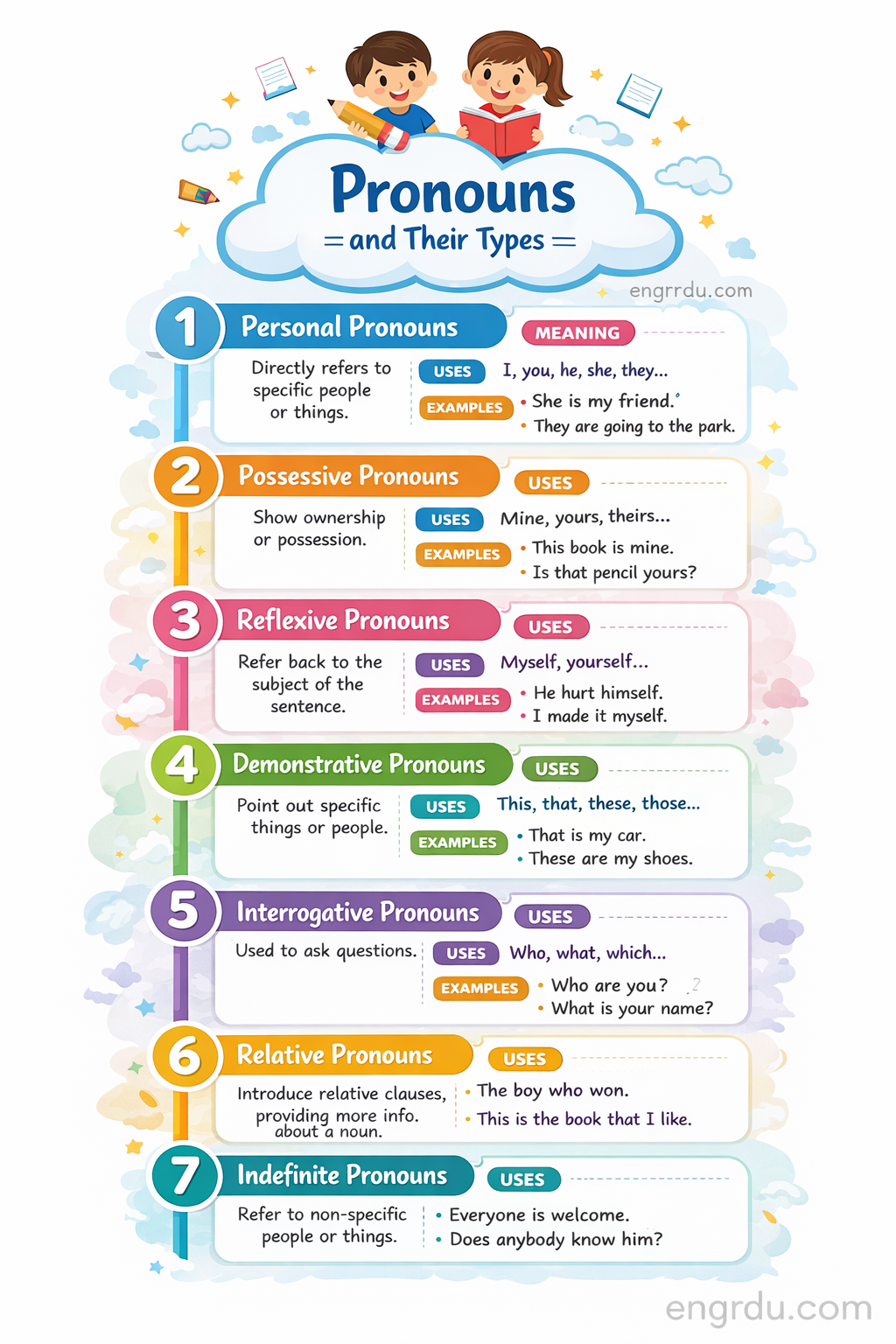
Types of Pronoun
Rules/Usage of Pronouns
Subject vs Object Pronouns
- Subject pronouns are used as the subject of a sentence: I, you, he, she, it, we, they
- Object pronouns are used as the object of a sentence: me, you, him, her, it, us, them
Example:
- He likes ice cream. (subject)
- I saw him yesterday. (object)
Agreement with Nouns
Pronouns must agree with the noun they replace in number and gender.
Example:
- The boy lost his book.
- The girls love their teacher.
Reflexive Pronoun Usage
Reflexive pronouns are used when the subject and object are the same.
Example:
- She taught herself to play the piano.
Avoid Ambiguity
Make sure it is clear what the pronoun refers to.
Example:
- Wrong: John told Tom that he would help. (Who is “he”?)
- Correct: John told Tom, “I will help you.”
Common Mistakes with Pronouns
Using the wrong pronoun:
- Wrong: Me is tired.
- Correct: I am tired.
Mixing singular and plural:
- Wrong: Each student must submit their homework. (for formal writing)
- Correct: Each student must submit his or her homework.
Using pronouns without clear reference:
- Wrong: Tom told Jack that he was late. (Who is late?)
- Correct: Tom told Jack, “You are late.”
Pronoun Types Chart
| Pronoun Type | Use | Example |
|---|---|---|
| Personal | Specific people/things | I, you, he |
| Possessive | Ownership | mine, yours |
| Reflexive | Subject refers to itself | myself, herself |
| Demonstrative | Pointing to something | this, those |
| Interrogative | Asking questions | who, what |
| Relative | Connecting clauses | that, which |
| Indefinite | Non-specific | someone, many |
List of Pronouns
| Personal Pronouns | Possessive Pronouns | Reflexive Pronouns | Other Pronouns |
|---|---|---|---|
| I | mine | myself | this |
| you | yours | yourself | that |
| he | his | himself | these |
| she | hers | herself | those |
| it | its | itself | who |
| we | ours | ourselves | whom |
| they | theirs | themselves | whose |
| me | — | — | which |
| him | — | — | what |
| her | — | — | someone |
| us | — | — | anyone |
| them | — | — | everyone |
| — | — | — | nobody |
| — | — | — | something |
| — | — | — | everything |
Pronoun Examples in Sentences
| Pronoun | Example Sentence |
|---|---|
| I | I am going to the market. |
| you | Are you ready for school? |
| he | He is my best friend. |
| she | She likes chocolate ice cream. |
| it | It is raining outside. |
| we | We are watching a movie tonight. |
| they | They are playing football in the park. |
| me | Can you help me with this homework? |
| him | I saw him at the bus stop. |
| her | I gave her a birthday gift. |
| us | Please join us for dinner. |
| them | I called them yesterday. |
| my | My bag is on the table. |
| your | Is this your pen? |
| his | His shoes are very clean. |
| her | Her dress is beautiful. |
| its | The dog wagged its tail. |
| our | Our classroom is very bright. |
| their | Their house is near the river. |
| mine | This pencil is mine. |
| yours | That book is yours. |
| his | This is his car. |
| hers | That phone is hers. |
| ourselves | We enjoyed ourselves at the party. |
| yourself | Take care of yourself. |
| himself | He taught himself to play guitar. |
| herself | She prepared herself for the exam. |
| itself | The cat cleaned itself. |
| this | This is my favourite song. |
| that | That looks amazing! |
| someone | Someone is knocking at the door. |
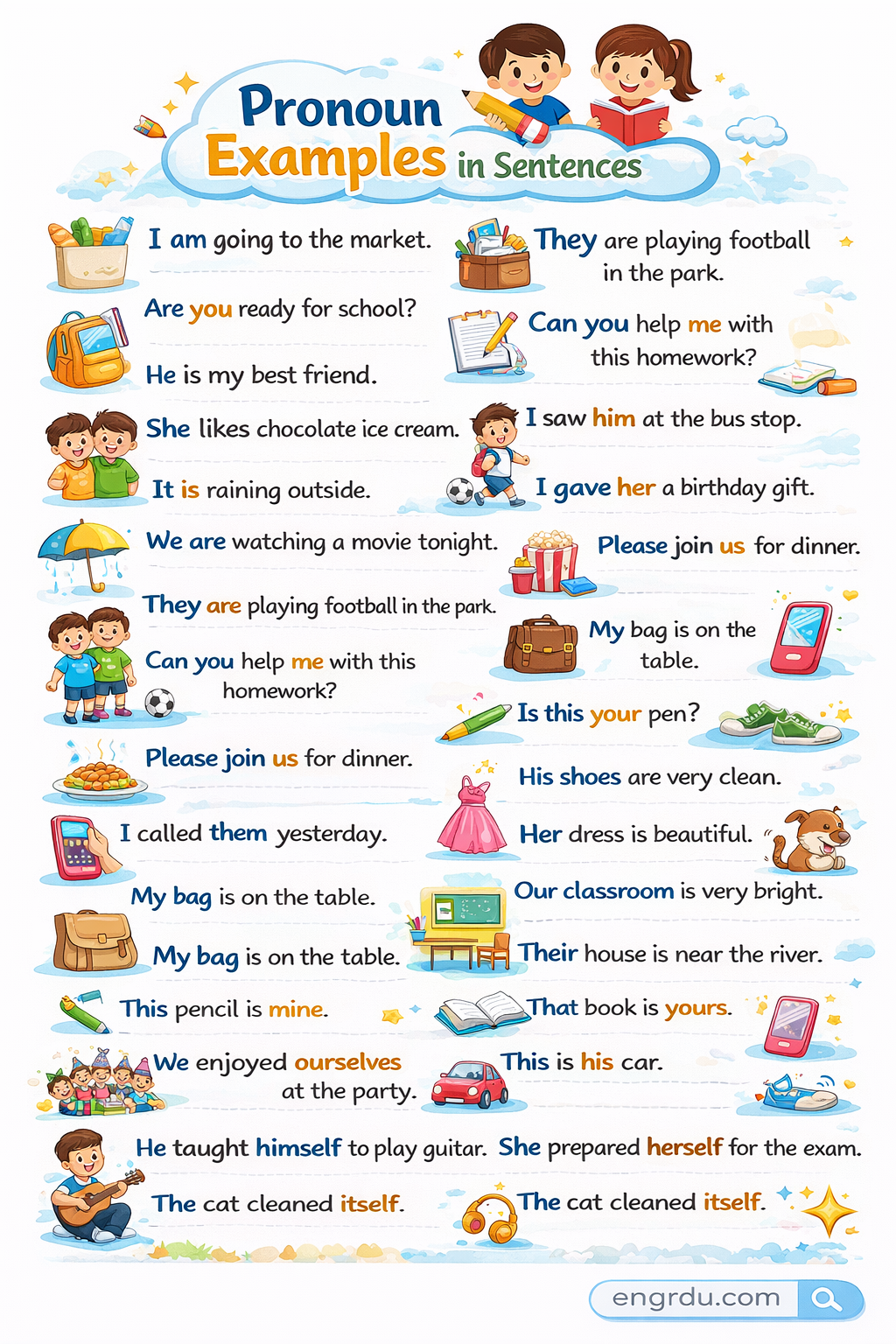
Pronoun Examples in Sentences
Tips for Learners
- Read sentences carefully to identify the noun a pronoun replaces.
- Match pronouns with nouns in number and gender.
- Use reflexive pronouns only when the subject and object are the same.
- Practice writing affirmative, negative, and question sentences.
- Avoid using pronouns if it makes the sentence unclear.
Conclusion
Pronouns are simple yet powerful words. They replace nouns, reduce repetition, and make sentences smooth. There are many types, including personal, possessive, reflexive, demonstrative, interrogative, relative, and indefinite pronouns. Learners should pay attention to agreement, clarity, and proper usage. By practising with examples and avoiding common mistakes, you can use pronouns confidently in both writing and speaking. Start replacing nouns with pronouns in your daily sentences, and you will see how much easier English becomes!
Frequently Asked Questions
What is a pronoun in English?
A pronoun is a word that replaces a noun in a sentence. It helps avoid repetition and makes sentences easier to read and speak. Examples include I, you, he, she, it, we, and they.
What are the main types of pronouns?
The main types of pronouns are personal, possessive, reflexive, demonstrative, interrogative, relative, and indefinite pronouns. Each type has a specific use in sentences.
How do personal pronouns work?
Personal pronouns represent specific people or things. Subject pronouns like I, you, he, she, it, we, they are used as the subject, while object pronouns like me, you, him, her, it, us, them are used as objects.
What is the difference between possessive adjectives and possessive pronouns?
Possessive adjectives (my, your, his, her, our, their) come before a noun, while possessive pronouns (mine, yours, his, hers, ours, theirs) replace a noun to show ownership.
When should reflexive pronouns be used?
Reflexive pronouns like myself, yourself, himself, herself, itself, ourselves, yourselves, themselves are used when the subject and object of a sentence are the same. Example: I taught myself to play piano.
Can you give examples of demonstrative pronouns?
Demonstrative pronouns are used to point to something specific. Examples include this, that, these, and those. For instance: “This is my book” or “Those are beautiful flowers.”
What are common mistakes learners make with pronouns?
Common mistakes include using the wrong pronoun (Me is tired → I am tired), mismatching singular and plural forms, or using pronouns without clear reference. Always check agreement and clarity in sentences.
Read More




Leave a Comment